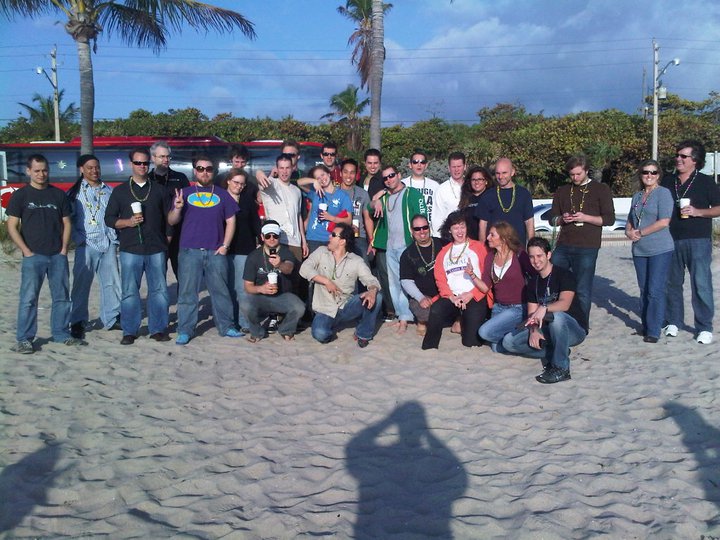
Miami Bus Group Shot

Brainstorm an idea, and launch a fully-functioning company based on it… in 72 hours. On a bus.  If it’s good, it will become a real company, backed by serious venture capitalists. P.S. Don’t expect to sleep.

Linked with Austin, SXSW (SouthBySouthWest), the Startup Bus is like a mobile Startup Weekend, with elements of Amazing Race. Six busses leave from six different cities, carrying about 30 or so “buspreneurs” per bus. They hit the road at the same time, and dream, code, design, collaborate and project manage their way to Austin, to present their business to a group of venture capitalists at the SXSW conference.

Dreamt up by Elias Bizannes and a group of like-minded entrepreneurs, nerds and VCs, the first Startup Bus took its maiden voyage from San Francisco to Texas last year. It was such a roaring success that Elias convinced six of last years participants to act as bus conductors, on a six-fold larger venture. The conductors’ job is to advise, mentor, and help sleepless buspreneurs differentiate between workable business concepts and those that are completely nutty.
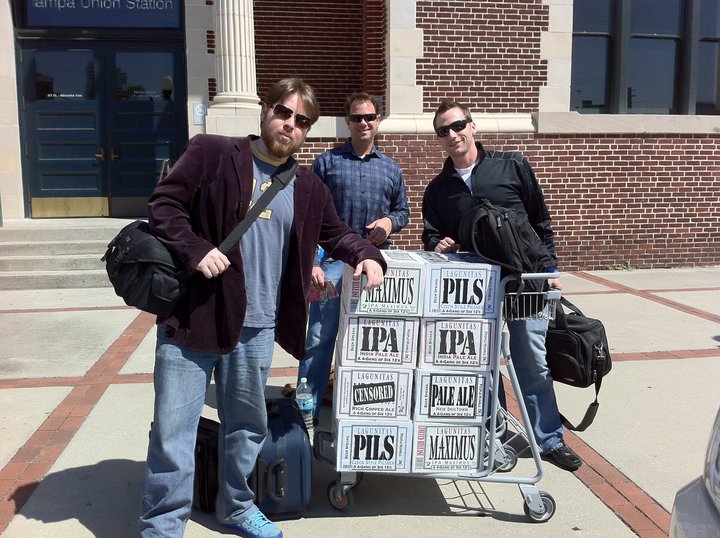
Tampa Team Sponsored By Lagunitas

The buses left from San Francisco, Chicago, Cleveland and New York.  I was on the Miami bus with a ­ mix of geeks from Miami, Baton Rouge and Tampa. The Tampa folks took an Amtrak down to Ft. Lauderdale, strategizing before being thrown into the fray. We rendezvoused with our fellow Southern nerds, enjoyed a night of merriment and then packed our digital cameras, MacBook Pros, Android tablets and other tech geek junk, and headed towards Austin.

Once aboard, our conductor, Steve Repetti, was ready with a microphone. Anyone with a business idea could pitch the business plan to the rest of the bus, to attract others to the nascent company.  Once groups were formed, the work began.  The Tampa group had mostly split itself between two projects: First was Story-Set-Go, a mobile phone application designed to allow budding film makers to easily shoot events using narrative templates in storyboard form, paired with an online marketplace for experts to sell their storyboards to users; Second, and one of the strangest ideas, was MyNewman.com. Touted as “The Anti-Social Social Network”, MyNewman.com would be an anonymous social network where unlike-minded users would be matched with others who they would naturally dislike. From there, they would be encouraged to argue with each other as well as purchase digital pranks to play on each other’s profiles. I somehow ended up working for both of these projects.

The Startup Bus Tampa Crew

What was truly astounding was the quality of the people I got to work with. In a world were finding highly competent people is extremely difficult, I was surrounded by folks from right here in the Bay area who were not only competent but inspiring. Their creativity and follow-through often left me wishing that I could afford to hire people like this. And after four days of living, eating and working together without sleep, we had accomplished something extraordinary: Business, financial and technical models of our companies were presented to our illustrious panel of VCs. In fact, out of around 40 teams, MyNewman.com made the final six only to be beat out by a group from New York and a team from Silicon Valley. However, both Tampa teams are continuing to peruse their projects outside of the bus, and I cannot wait for next year’s trip.

Previous ArticleNext Article
I help companies turn their technical ideas into reality.

CEO @Sourcetoad and @OnDeck

Founder of Thankscrate and Data and Sons

Author of Herding Cats and Coders

Fan of judo, squash, whiskey, aggressive inline, and temperamental British sports cars.

Leave a Reply

The Product Is Bait

You Don’t Know Yet

Founders don’t know what problem they’re solving yet, and neither do any of their customers, and the annoying part is that this is not actually bad news, because if you stay in it long enough, you will eventually figure it out.

The Product Is Bait

The way it usually goes is this: You build something that takes a particular angle on a particular problem in a particular industry (probably one you know pretty well, or think you do), and one of two things happens. You either get sucked into a kind of product development haunted house where it has to be just a little more complete before it’s ready, and the dashboard needs better onboarding, and what if it had a Slack integration, and maybe the logo should feel more “enterprise” (I have never once heard a satisfying definition of what “enterprise” means as an aesthetic), or you get a version out the door and into the actual market, where it doesn’t sell. Not selling is, counterintuitively, on ok outcome. It won’t feel good, it’ll feel like capitalism personally singled you out for a lesson, but what you have now is a real artifact that maybe 1% of your original intended market can react to, and that 1% is enormously valuable because real reactions are the only raw material that matters. You can now take that product (which is bait, more than anything else) and you start showing it to ten, twenty, thirty potential customers, watching their faces and listening to what they complain about.

Feature-Requested to Death

At first, they will try to feature-request you to death. These requests will feel very convincing because customers say things like “if it could just hook up to our QuickBooks instance, I’d buy it tomorrow” or “if the AI could handle this last piece of the workflow, this would be an absolute game-changer for us” (they will ALWAYS ask if it can export to Excel, a request I believe predates the spreadsheet and may outlast the species). So you go back to your team, you build as fast as you can, you ship version two with all the new features, you go back to those same customers, and if you are good, AND lucky they will tell you the exact same thing: there are just one or two more features they really need, and then this thing will fix the problem once and for all, and you are almost there.

The Roadmap Graveyard

I’m going to pause the loop here because it can go on for twenty iterations (and I’ve seen it go longer). The real tragedy is that a lot of founders never even get this far, because their demo customers have them trapped in feature-development purgatory forever… or their own brains trap them there, because the product has to be perfect before any real human is allowed to see it. Those products die in roadmaps and “just one more thing” conversations, and never get rejected by the market because they never actually reach it.

Eventually, You Start Seeing the Elephant

But if you can stay in the conversation long enough, past the feature requests and the individual customers and the literal words people are saying to you, something strange starts to happen. You become, through sheer accumulated exposure, the world’s leading expert on the problem your customers all have in common. Not the problem you thought you were solving when you started, and not the problem any one of them has described to you, but the actual structural problem that everyone is bumping into from different directions (Schlep Blindess) without being able to name it, because nobody has a view of the whole thing. One customer tells you it’s the accounting system. Another says it’s logistics. A third says the two systems don’t talk to each other. A fourth blames someone named Susan in operations (this may or may not be fair to Susan… but yeah, wtf Susan?) Each of them is holding a piece of the elephant, the trunk or the tail or the foot, and describing it with complete sincerity, and they are all correct about their piece, and none of them can see the animal.

You, Neo, Are The One!

You are the only person who has talked to all of them, which means you are the only person positioned to eventually see the whole thing. The insight doesn’t come in a meeting and it doesn’t come from a good customer interview; it comes sideways, usually while you’re not looking for it. You’re at lunch with a client and one of their direct reports walks in with a quick question, and two people start having a conversation right in front of you, and the boss asks why the system can’t do something, and the user explains the workaround, and a third person adds “we only do it that way because finance needs the numbers by Thursday,” and a piece clicks, and then another, and then another. You suddenly understand that the product you built wasn’t the product at all; it was the thing that got you close enough to understand what the actual product should be, which turns out to be a considerably more interesting thing to build.

Earning the Right to Understand

The first version won’t be right, and the second version probably won’t be right either, and that is not failure… that is the process of earning the right to understand what you’re actually building (see Paul Graham’s “How to Get Startup Ideas“). Most founders want to skip straight to the insight, want the clean customer discovery process and the tidy MVP and the market telling them in bullet points exactly what to build, and that is just not how it works. You build the wrong thing, you launch it, you survive, you talk to as many customers as you can stand, you resist becoming a short-order cook for every prospect with a credit card, and you keep looking for the pattern underneath all the noise until eventually you see the elephant.

That’s when the real company starts.